Contents
Overview
Game Concept
   -Introduction
   -Background
   -Key Features
Concept Presentation
Research Report
   -Types of research
   -Source Comparison
   -Feedback survey
   -Secondary research
Distribution
   -Audience
   -Marketing
   -Target platform
Game Design
   -Themes
   -Environment
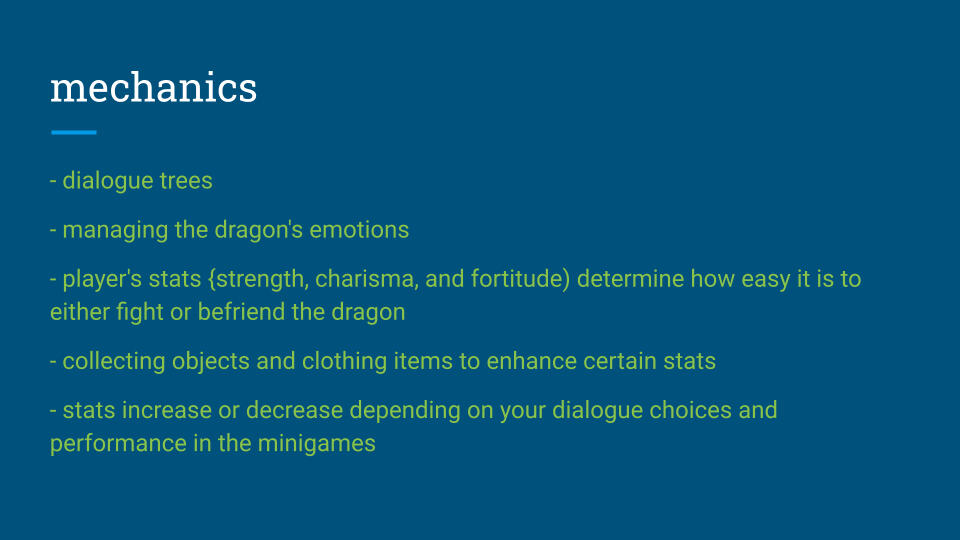
   -Mechanics
   -Objectives
   -Types of fun
Concept art
Evaluation
References

Game overview

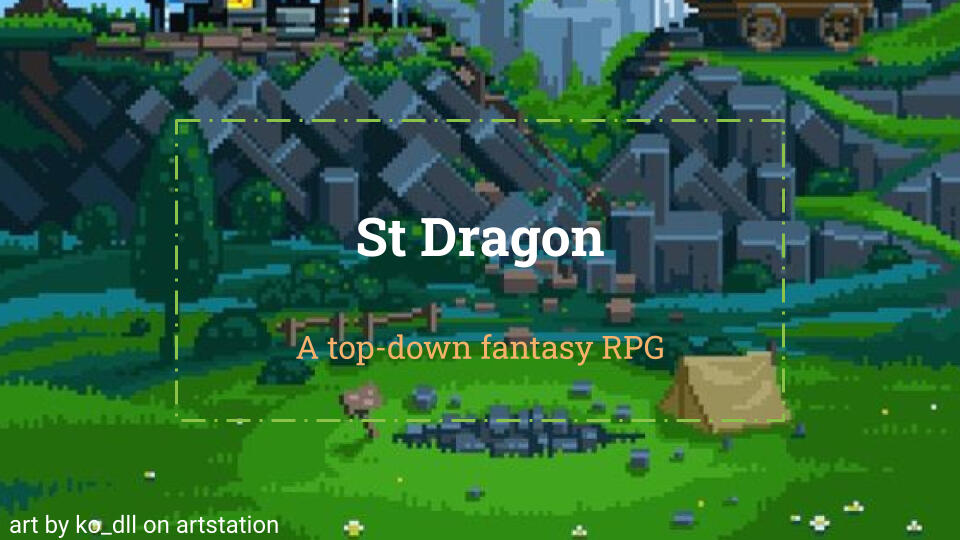
TitleSt Dragon
FormatDigital
GenreTop-down fantasy RPG
LanguageEnglish
TerritoriesUnited Kingdom
PlatformPC/Windows

St George is a knight who has been put in charge of protecting his kingdom. But when an unknown menace starts destroying people's homes and disappearing without being seen, he suspects a dragon that lives nearby is at fault, and sets out to defeat it. During the first battle, St George soon finds out that he is not nearly strong enough to defeat it by force. The player must instead use George's social skills and activities in the surrounding area to gain the dragon's trust, in hopes of having a chance of defeating it.
The final battle may not be what was intended however, as it turns out the one wreaking havoc on the kingdom wasn't the dragon after all.

Game Concept

Introduction

St Dragon is a lighthearted top-down RPG that puts the player in the shoes of the knight St George, who has been tasked with defeating a dragon using some unconventional methods, inspired by the legend of St George and games like Undertale. The aim of the game is to gain the dragons trust through dialogue trees, collecting items, playing minigames, and exploring the kingdom.


Background

A big inspiration for this game was Undertale, which is also a top-down 2D RPG, and is also made with the GameMaker engine. The main feature of Undertale that inspired my own game, was the combat. Specifically, the option to either fight or befriend the monsters you encounter, as well as influencing the game's ending depending on whether you decided to spare monsters or kill them. I will be using a similar concept in St Dragon, as well as the ability to change the final outcome of the game depending on what options you choose.Also included in this game is former WWE fighter John Cena. He features as a "final boss" of sorts. For some reason.


Key Features

- Choose the fate of the main characters: there are multiple different endings to achieve depending on how you treat the characters and what actions you decide to take.
- Role-play a medieval knight. Or don't: you can explore, collect in, and interact with this world however you wish, and dress yourself with whatever clothes you find. It could be unbecoming of a man of your position, but perhaps it will work out in your favour.
- Reactive NPCs: other people (and dragons) in your world will react to how you behave and dress, and if you have poor social skills, they'll notice!
- Play mini-games with a dragon: who hasn't wanted to beat a mythical beast at table-tennis at least once?
- You can't see him: unexpectedly, expect to see American actor and former rapper John Cena.

Concept presentation


Speaker notes:
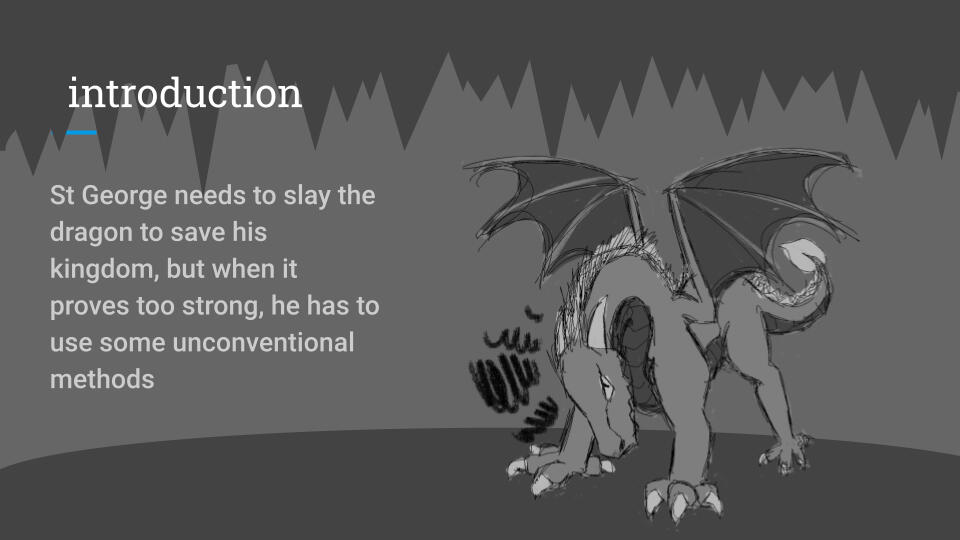
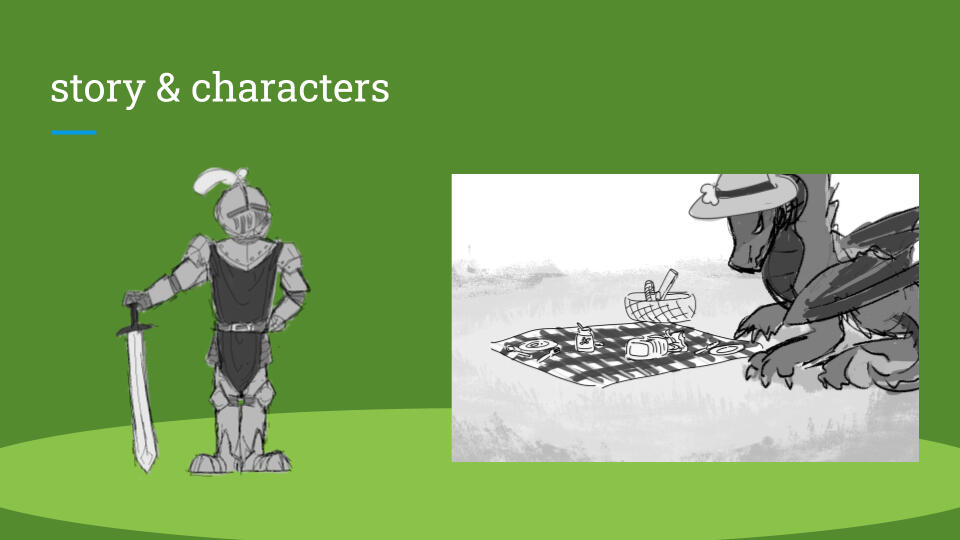
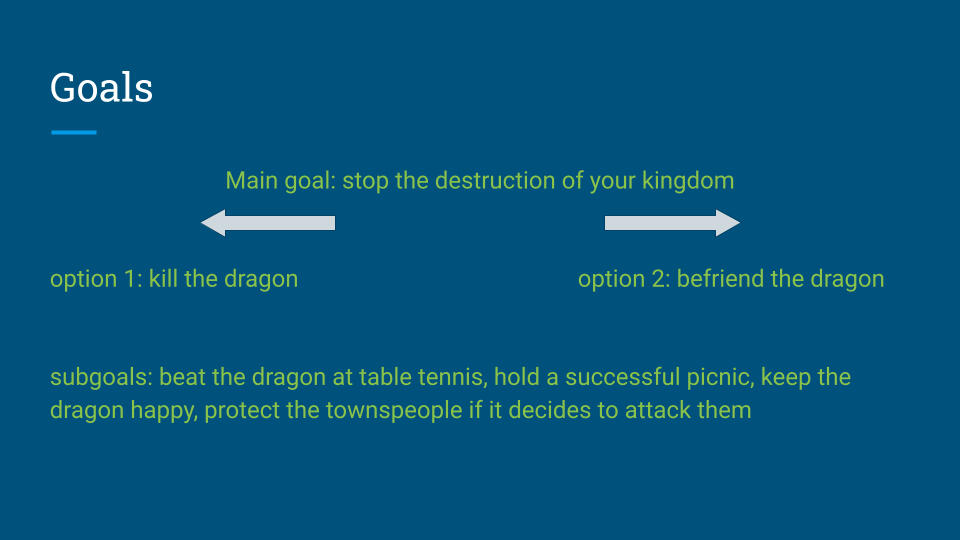
Our characters are of course St George and the dragon, but the whole reason George has been tasked with slaying it is because of a mysterious beast destroying homes and stealing livestock all over the kingdom. You are too weak to fight the dragon on your own, so you must gain its trust through friendly activities and the use of social skills, to either inevitably attempt to kill the dragon (with new knowledge of its weaknesses), or just try to be its friend and eventually find out it wasnt the one wreaking havoc in the first place

Speaker notes:
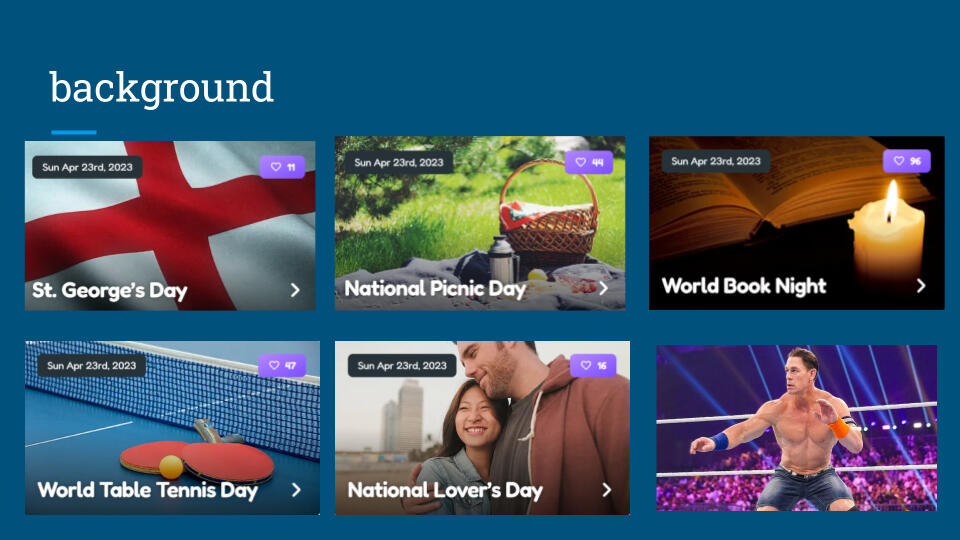
My inspiration was the national days on my birthday, the 23rd of april. Apparently, there are lots of days, so I got a lot of inspiration from my many options. The ones I ended up mainly using were St George's day, national picnic day, world book night and world table tennis day. I also included national lovers day here because its are kind of included in the themes of the game anyway. John Cena was also born on my birthday, so I considered making him the mysterious creature destroying the kingdom, so that if you befriend the dragon you both have to fight john cena

Speaker notes:
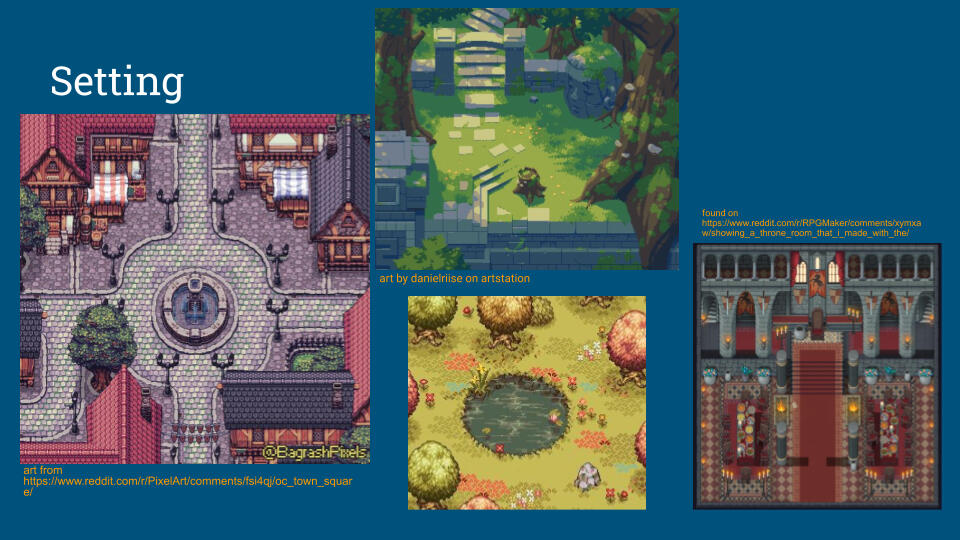
The setting is a fantasy kingdom in dubiously-accurate medieval england, based around the legend of St George.

Speaker notes:
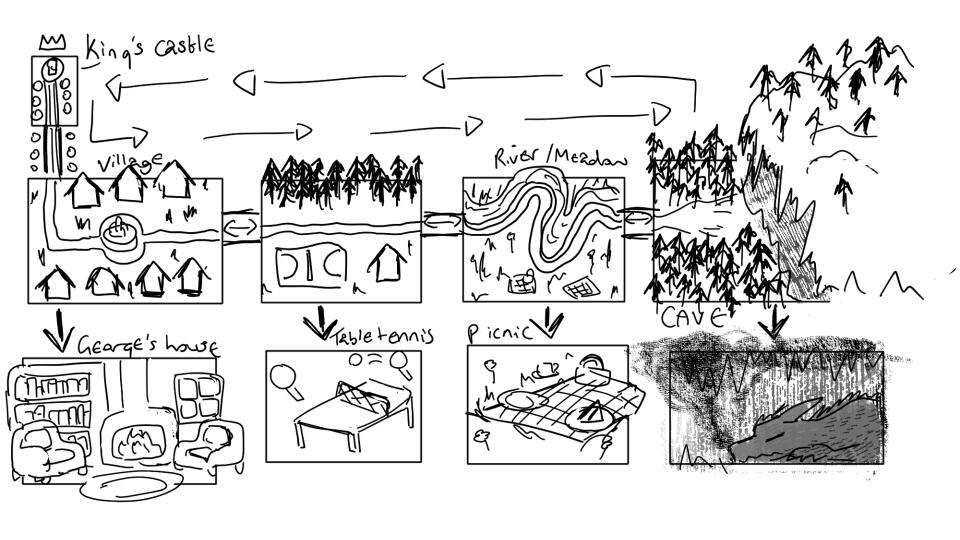
Here is a prototype of the map of my game. You start at the king's castle and make your way to the dragon's cave, before bringing it back the way you came and completing minigames with it to unlock dialogue and help you in your quest

Speaker notes:
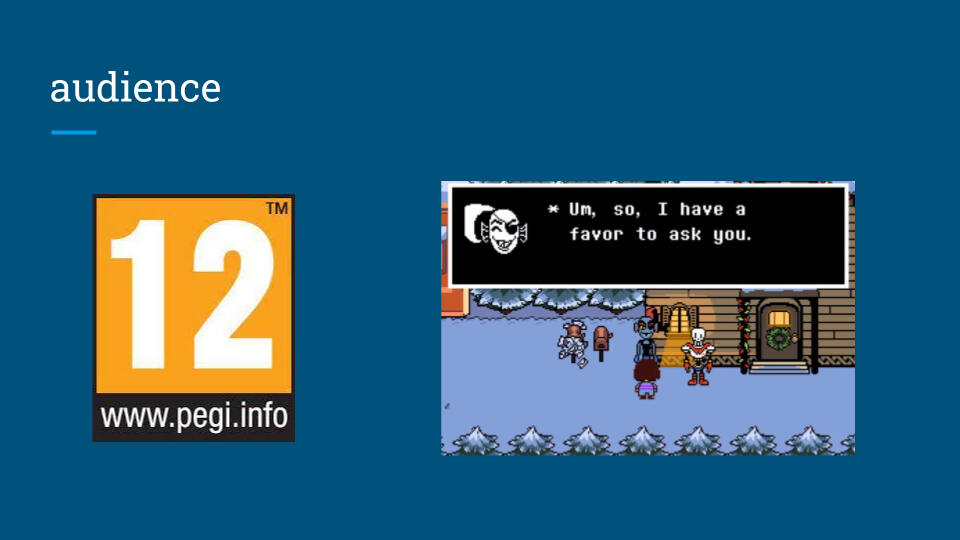
My game is pegi 12 because I think my target audience are those 12 to 30. I think it would attract those who enjoy lighthearted and story-based games like undertale

Research report

Before I show the research for my game, I will summarize the different types of research and their benefits (or drawbacks)

Primary research

Primary research encompasses all research you do yourself. It's usually done for a specific purpose and is entirely original data.
Examples of primary research sources are:

Questionnaires & Surveys
  - A quick and relatively easy way to collect opinions in an accessible way
  - Very versatile. Can be used to ask yes/no questions, questions on a numerical scale, or prompt longer written opinions
  - On the other hand, it requires having people to answer the questionnaire, which in some circumstances could be difficult
  - If you don't monitor where your survey is going & who it's going to, you may end up inadvertently only receiving responses from a specific demographic
  - The quality of responses can also vary greatly
Interviews
  - Interviews are valuable for more in-depth answers, where the interviewer can ask questions related to the responses of the interviewee
  - The drawbacks of interviewing are that it is very time-consuming to both organize and complete, and as such is very likely to be limited to only a few interviewees
  - The data you receive from interviews may also be difficult to parse into usable information, depending on how it is recorded
Focus Groups
  - Focus groups can show a more accurate picture of a group of people's opinion on what you are researching
  - There may be a few leading questions or topics presented by the host, but the group's discussion is much more freeform than in a 1-on-1 interview
  - It also has a larger sample size than interviews, but much like interviews, they are also time consuming to organize and perform
  - There will also be a lot of data to go through, which will be time consuming


secondary research

Secondary research is all research that isn't done by the researcher. It can be used alongside/to supplement primary research.
Examples of secondary research sources are:

Peer-reviewed Articles & Reports
  - Peer-reviewed works are useful for fact-checked information, and are considered a very credible resource
  - The writers of these articles are usually considered experts in their subject
  - One of the major drawbacks is that such articles and papers can often be behind paywalls, which creates a barrier when researching
  - It is also incredibly important to reference peer-reviewed works correctly, because otherwise would be considered plagiarism
Online Non-peer-reviewed Media
  - This source of information is incredibly quick and simple to find & access, as well as there being lots of it, making it easy to use
  - They are often biased or based on opinions, which can both be a negative aspect (if you want unbiased information), or positive (if you are looking for public opinions on a subject)
  - Because of the lack of peer-review, the unfortunate consequence is that you have to fact-check what you read, since not everything you find will be accurate
  - It is also important to reference non-peer reviewed media correctly
Real-world media
  - Real-world sources are often in-depth and cover a variety of topics
  - It is more likely to contain accurate info because it is likely to have been checked over before it was published
  - It is however not guaranteed to be accurate or unbiased, and may be outdated
  - It may also be difficult to get a hold of. Either hard to find or because it costs money


Quantitative

Quantitative data is data that can be shown as a set of numbers and can be measured. It is also often displayed as charts and graphs.
Examples of quantitative sources are surveys and polls.

Pros
  - Its use in charts and graphs and be useful for displaying your data in a visual, easy-to-understand way
  - It's a lot faster to collect and process quantitative information
Cons
  - Doesn't provide much detail in its information
  - Quantitative data isn't immune to bias (either in the collection or interpretation of the data), but because it deals with numbers, it can be very easy to present the data in a way that makes it SEEM unbiased
  - Some researchers may find processing lots of number difficult, or struggle with interpreting numerical data


Qualitative

Qualitative data deals with people's opinions and any information that is not numerical or able to be measured. It is often subjective and may be personal thoughts and feelings on a topic.
Examples of qualitative sources are interviews, focus groups, and questionnaires

Pros
  - Encompasses many forms of media (eg. video, text, audio)
  - Allows you to record more complex data
  - You can have much more nuance with qualitative data
Cons
  - The information can be more time-consuming and difficult to process and interpret
  - By nature of recording people's personal opinions, the data you receive is often very biased

Source Comparison


Primary VS. secondary

There are definitely benefits and drawbacks to both primary and secondary sources of information, mostly with the effort involved in collecting the data.
Primary research, such as questionnaires, are useful when you need specific information about your project, and are of course very versatile and able to be customized to your needs. While they take much more time, effort, and sometimes money to create and collect data for, it is invaluable to have data that you specifically need for your research.
On the other hand, even though secondary research, like peer-reviewed reports, are limited to only what other people have written and published, they require minimal effort to access and are usually well-researched with detailed information about that topic. Not only that, but peer-reviewed media often has references to other articles on that topic.
In my opinion, both primary and secondary sources are necessary for well-rounded research. For this reason, I have used both types of research when collecting information for my game.
The secondary sources I used were mostly online media, both peer-reviewed and not, but I also used the primary source of a survey. The use of a questionnaire allowed me to gather specific information about my game that I wanted, and then I used peer-reviewed articles on video game demographics and other non peer-reviewed online media to support the information I retrieved from my questionnaire and to inspire me further.


Questionnaire vs interview

In order to collect information on how I should proceed with developing my game, I presented the game concept to my games development class, and ended the presentation with a feedback form for them to fill out.
In my opinion, this was the most effective way to receive the feedback data that I wanted, because it was relatively quick and painless to write the survey, and it was very easy for others to fill out, so I got a number of responses.
On the other hand, if I'd decided to stage interviews instead of using a survey, that would have costed me a lot of time and effort to arrange, conduct, and record.
There are definitely benefits to interviewing that I would have appreciated, for example having a greater depth of answers and the opportunity to get the interviewees to expand on their thoughts about the game, but potentially interviewing up to 9 people just to get the variety of responses that I did was simply not viable in the time frame that I had to research for my game.


My Own Questionnaire vs online demographics report

I ended up using data from the Ofcom "Adult's media use and attitudes report 2023" to support my research into the target audience for my game, which highlighted to me the differences between using your own data from a survey you made, versus using data from a survey of another source.
I found that, while the Ofcom report was incredibly useful in finding out some general statistics to do with gaming, the information was very general and spanned topics that were of no interest to me, so I couldn't use the majority of the data in the report.
I also ran into an issue when trying to access peer-reviewed reports from other sources than Ofcom: I had to pay for them. Unfortunately I do not have the money to spend on demographic information, so a lot of my time was wasted trying to find online reports that were free to access.
On the other hand, while I was able to get more specific and in-depth data for what I wanted from my own questionnaire, it had very limited reach - only being available to my fellow students to answer. This means that the sample size was a lot smaller than I would have liked, and was certainly much smaller than the report by Ofcom, which provides valuable information about the population in general.


Feedback survey

All the information from this survey was created and collected by myself and for my game. I included both qualitative and quantitative questions, usually asking a quantitative question and then following with a qualitative opinion question to gain some insight and nuance on the numerical data.


Question 1
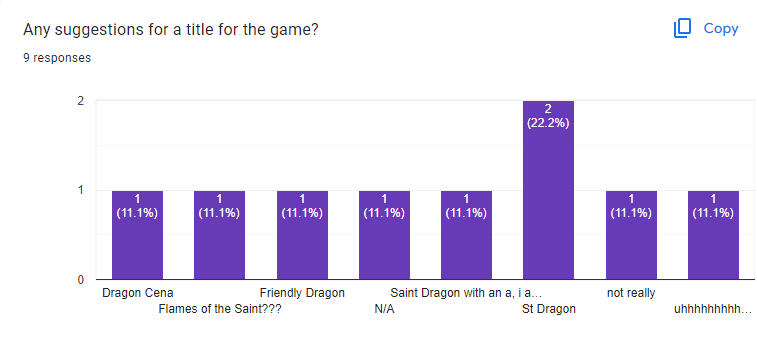
I included this question because I wasn't confident in my choice of game title and wanted to find out others' opinions on it.After reviewing this survey, I think I would have been better off asking how effective the title "St Dragon" is on a numerical scale, with an optional follow up box for suggestions, because over half of the answers didn't know what to suggest or simply agreed with my original response.


Question 2
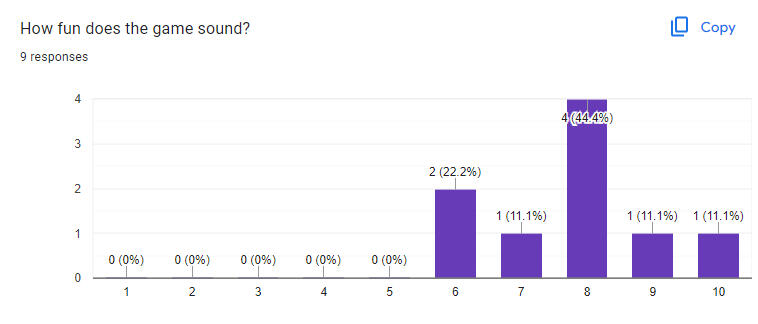
I used this quantitative question to gauge whether I needed to go over types of fun and change some elements of the game.


Question 3

I included this question as an extension of question 2, so that the responders could expand on the number they just gave.The responses I received I found helpful, as it illuminated the features that others are more likely to pick up on and find memorable.


Question 4
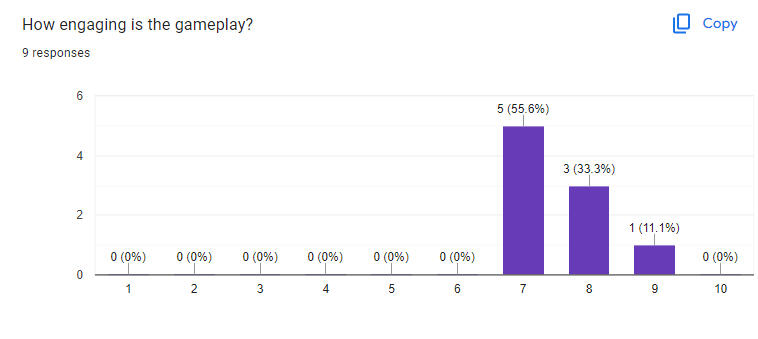
This question was similar to question 2, but more focussed on the mechanics of the game that I'd described.Just under half of the responses were either 8/10 or 9/10, with the remainder being 7/10, which I am happy with for now, as I will likely gather more feedback on my game mechanics as the creation of my game progresses.


Question 5
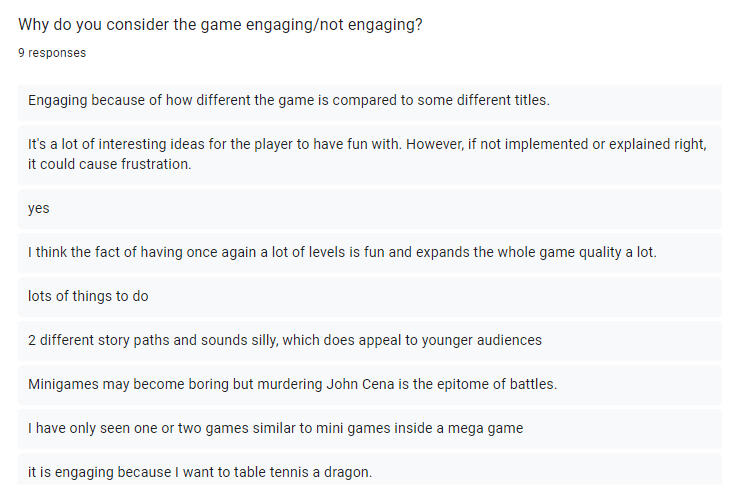
This is an extension of question 4, to expand on their answers.Again these answers I find useful in knowing what will hook people into my game, but also the responses about the minigames becoming boring/frustrating is valuable feedback and I will keep it in mind when developing my game further.


Question 6
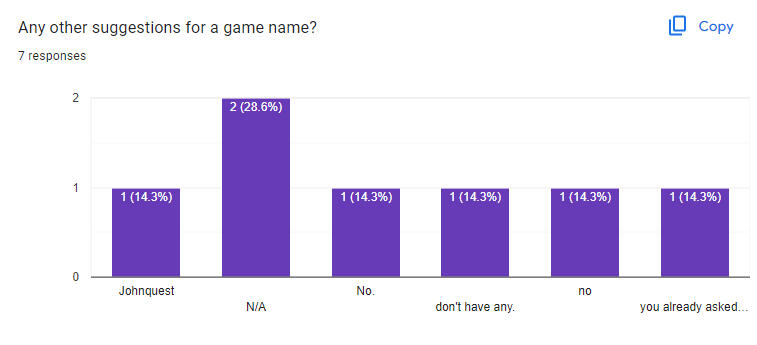
As you can see from the responses of this question, I accidentally asked question 1 a second time. Fortunately I don't feel that it majorly impacted on my survey, and most responders answered that they didn't have any suggestions anyway.


Question 7
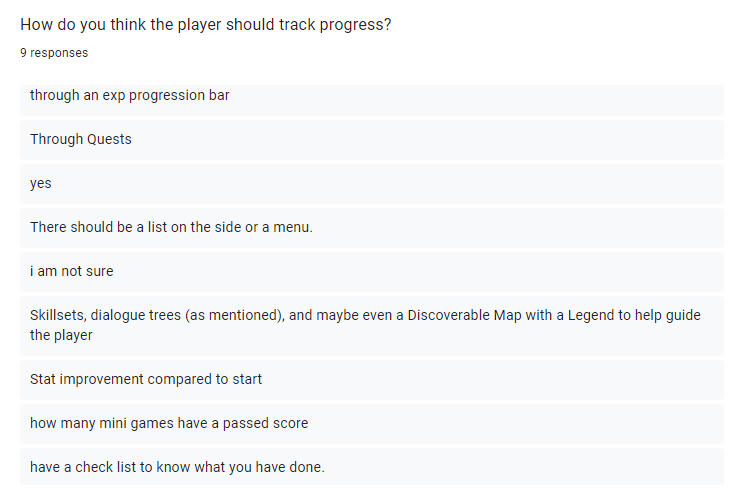
I included this question because I wasn't yet sure how tracking progress was going to happen.These responses helped me to solidify what I wanted to include: using both stat improvement and a checklist/quests


Question 8
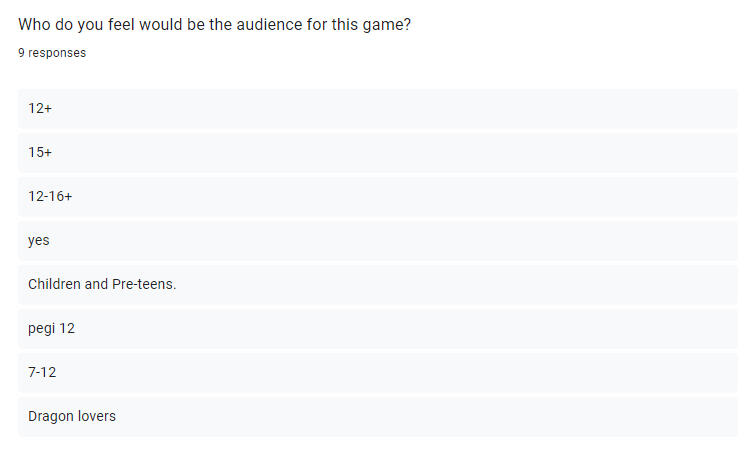
I feel like I could have perhaps made this question a multiple choice instead of a written answer, but regardless I find this feedback valuable when considering my target audience.


Question 9

I included this question because I wasn't entirely sure if the idea of including John Cena in my game was a little too goofy or out of nowhere, but the majority of respondents seemed to think it was a good idea!


Question 10
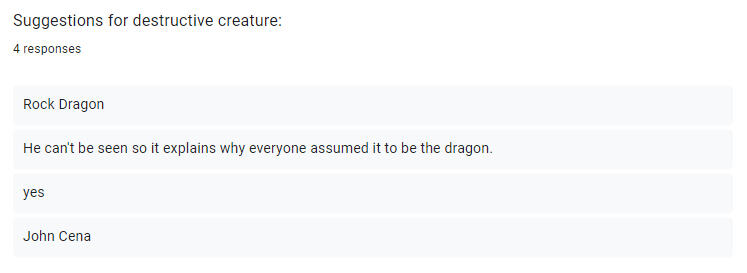
This question was optional, so there weren't many responses (also because most people liked the idea of John Cena), and only one of the answers for this section was actually usable.Because of the majority of respondents liking the more goofy idea of including pro wrestler John Cena, I will be going with that.


Question 11
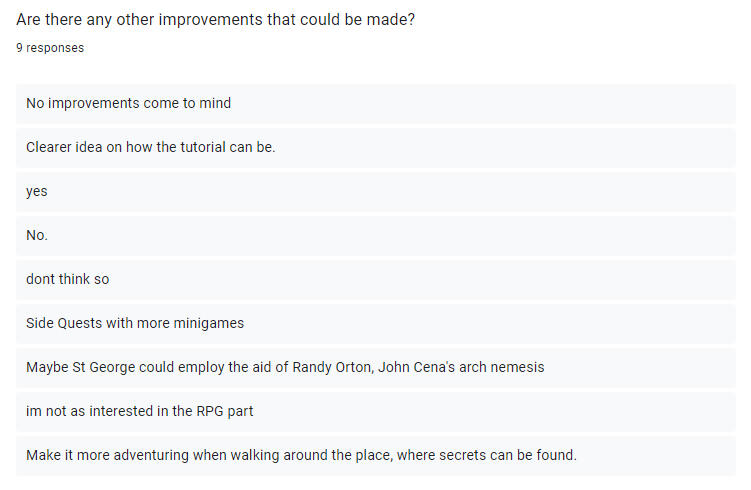
I took away some important things to consider from the responses of this final question.I will increase the number of mini-games and make the world the characters walk around in more interesting to explore, as well as including elements to show the player how to play the game.
Secondary research

There were several sources I came across while formulating ideas for my game that have influenced the development process:


initial inspiration

The original prompt for my game was to search up my own birthday (April 23rd) on https://www.daysoftheyear.com/ and use whatever days came up as inspiration.As it turns out, my birthday is quite popular for national holidays, so I got to pick a few, and the days I chose were:
- St George's day
- National Picnic day
- Read a Book day
- Table Tennis day
- Lover's day
Of course the star of the show here is St George's day, with my game being a spoof of the legend of St George and the dragon, but I used the other holidays on my birthday as inspiration for the minigames (picnics, reading, table tennis) and themes (love!).Apparently, famous pro wrestler John Cena is also born on April 23rd, and I wanted to incorporate him somehow for a bit of a silly twist at the end, so I incorporated him into the ending of the game as a boss battle of sorts.


AUDIENCE

According to data from Ofcom, the group of people who are most likely to play video games on any device are 16-24 year olds, with 25-34 year olds at 76%, and 35-44 at 67%. It is clear from this data that the target audience for games is young people younger adults.For my game's age rating, I checked Undertale, a game with similar gameplay to St Dragon, and the ESRB wikipedia page to gauge what it would be. Undertale is rated as an E10+ (AKA everyone over the age of 10), and from looking at the wiki page, I feel that my game will also be E10+, or likely even rated E, since there will be very minimal suggestive themes.I will follow the example of many other RPG games and upload it to play on Steam and itch.io, as I believe the biggest chunk of audience for my game will be on those two platforms


gameplay

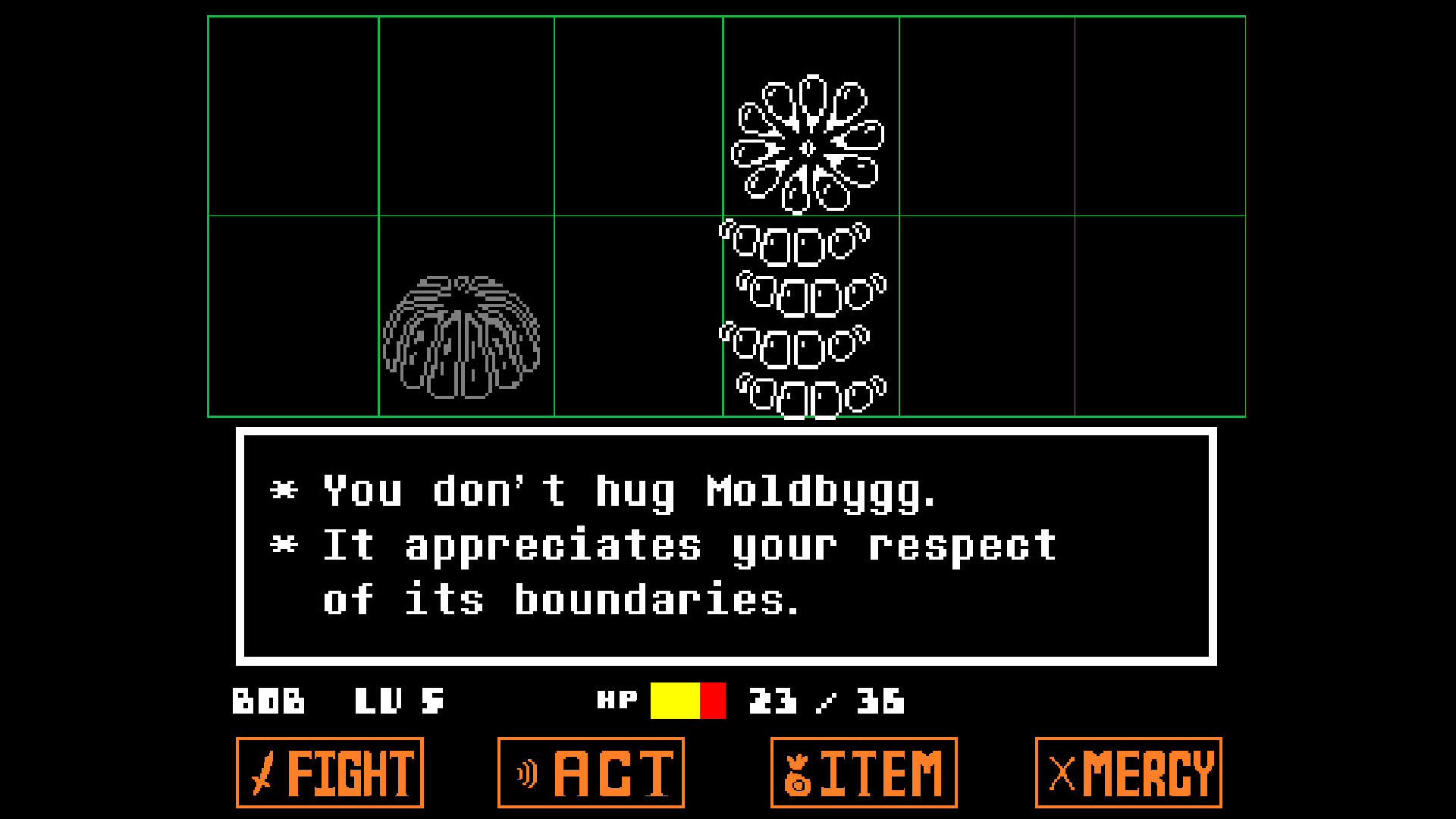
As stated previously, I found that Undertale had similar gameplay to what I imagined my game to be, so I used my experiences of playing Undertale to find out what I found fun about the gameplay and apply it to my own game.The biggest similarity is the mechanic of befriending the dragon instead of fighting it, which was a very large feature of Undertale, and from my feedback survey it appears to be a selling point for my peers as well, since they responded positively to the idea of befriending a dragon.

Screenshot of gameplay from scalar.usc.edu [Link]

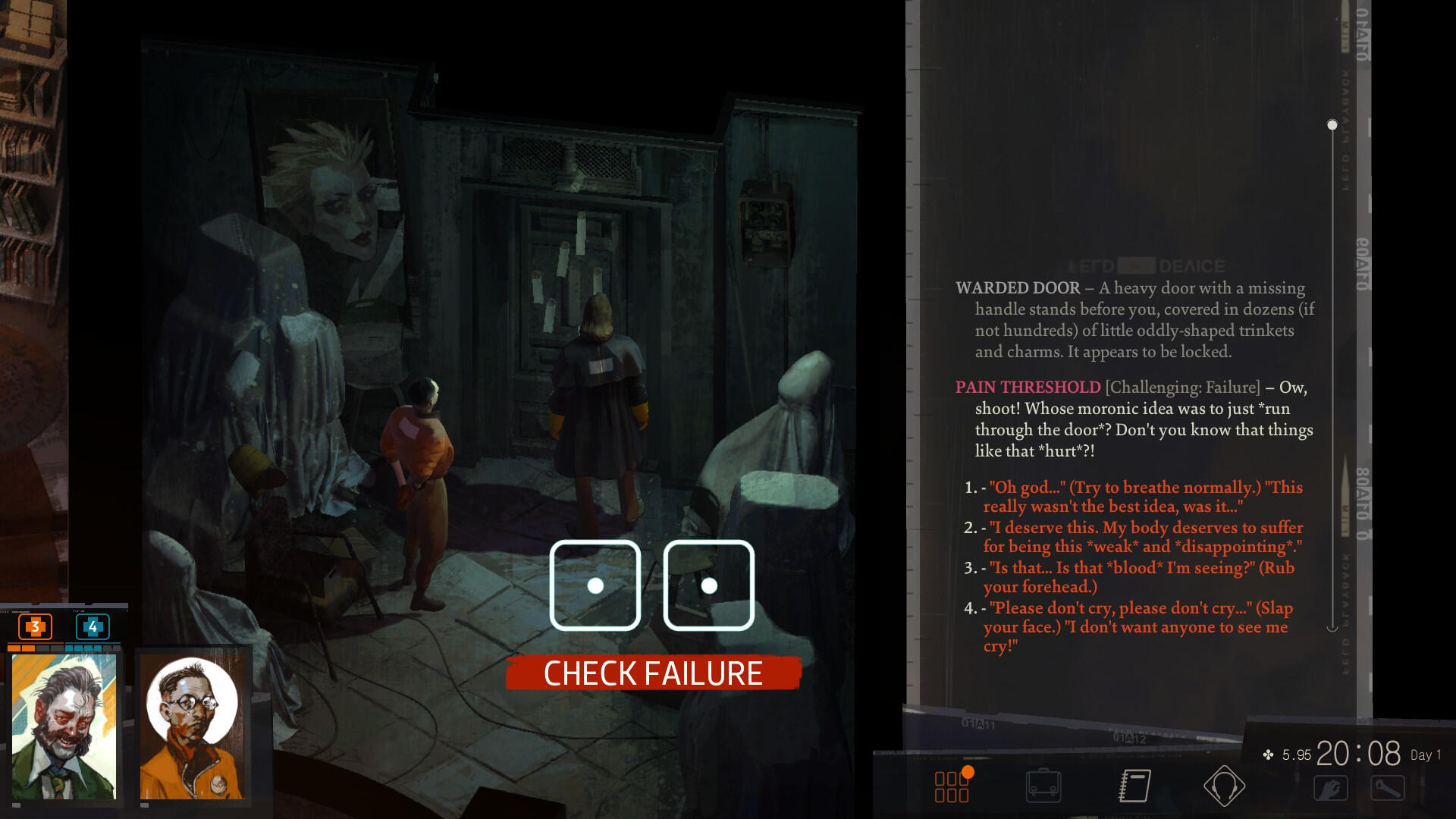
Another game that inspired my gameplay was Disco Elysium, specifically the dialogue system, but also the wide wide range of objects to pick up and clothes to wear that give you various stat boosts.
I find Disco Elysium's dialogue system incredibly unique and compelling, with the very realistic character reactions to whatever the player says/does, and the skill checks in conversation adding another layer of challenge.
My game's dialogue will naturally not be as dark as Disco Elysium, and will likely sacrifice a bit of realism to keep the game's tone lighthearted so as not to stray too far from the target audience.

Screenshot of gameplay by rpg.net user calliope [Link]


visuals

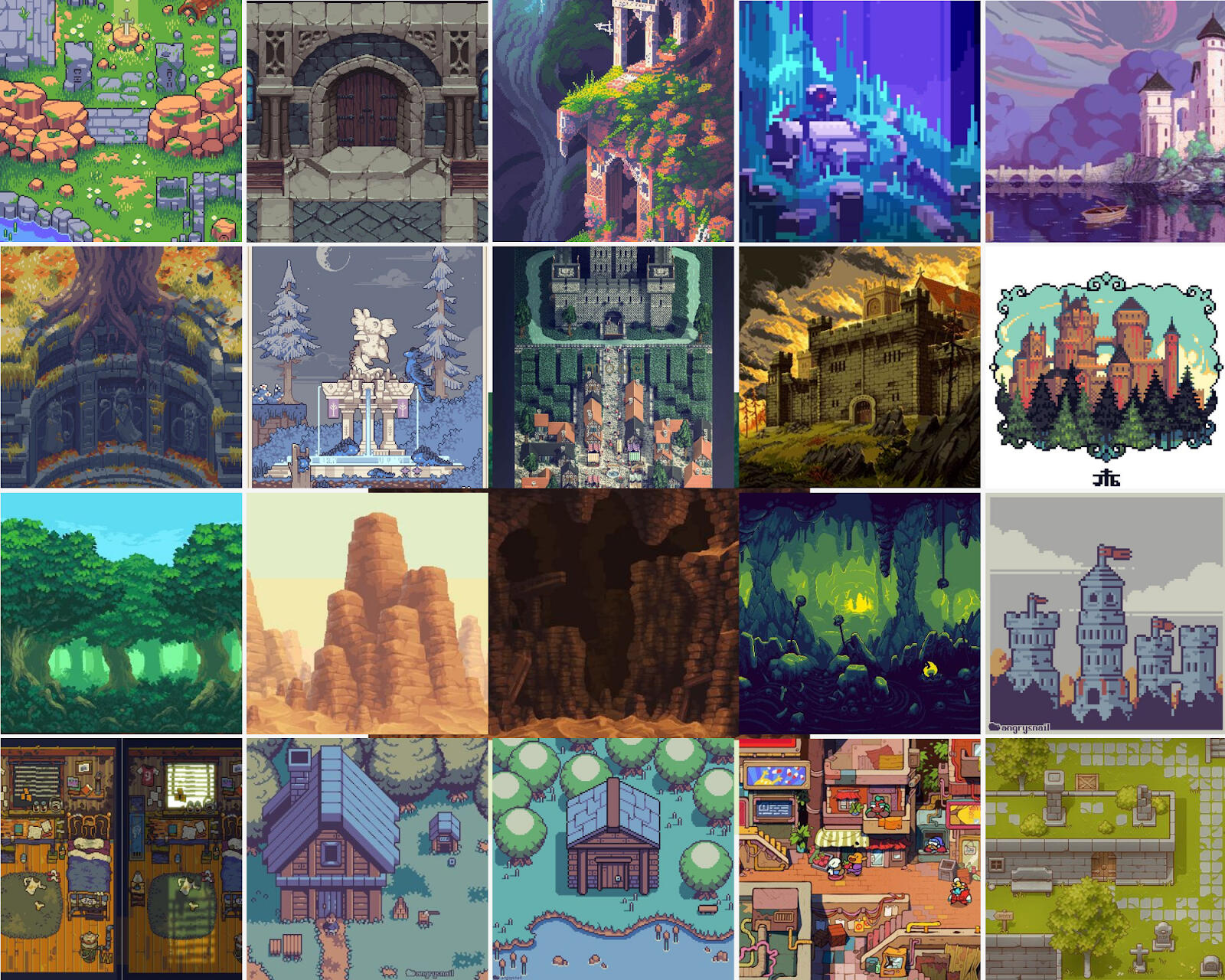
Here is a moodboard of pixel art environments that I put together from this Pinterest board at the start of my game's development that inspired me.

Because much of my inital visual inspiration was very foresty and medieval, I considered pixel art games I'd already played with somewhat similar aesthetics to try and figure out what exactly I liked about their artwork


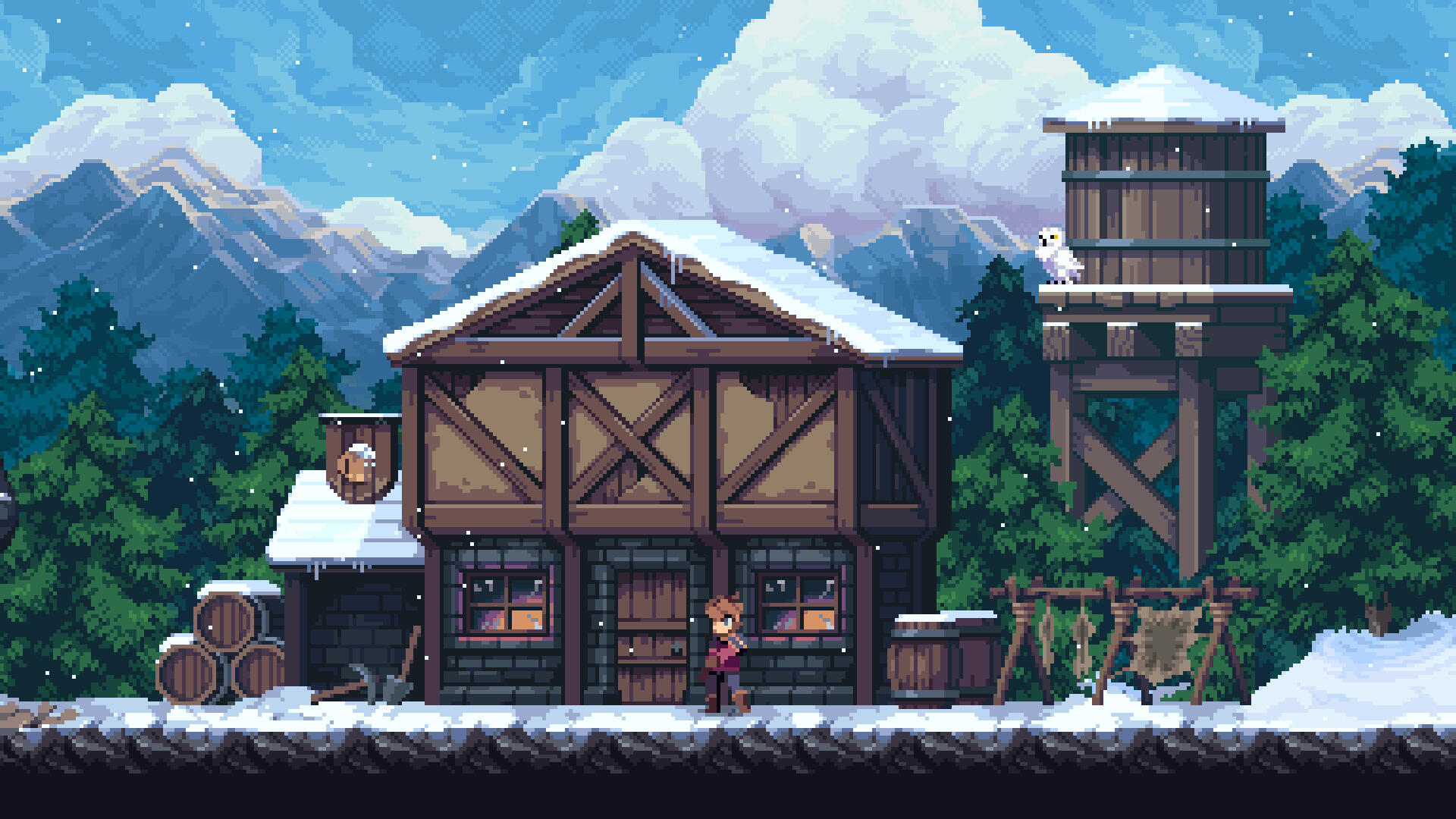
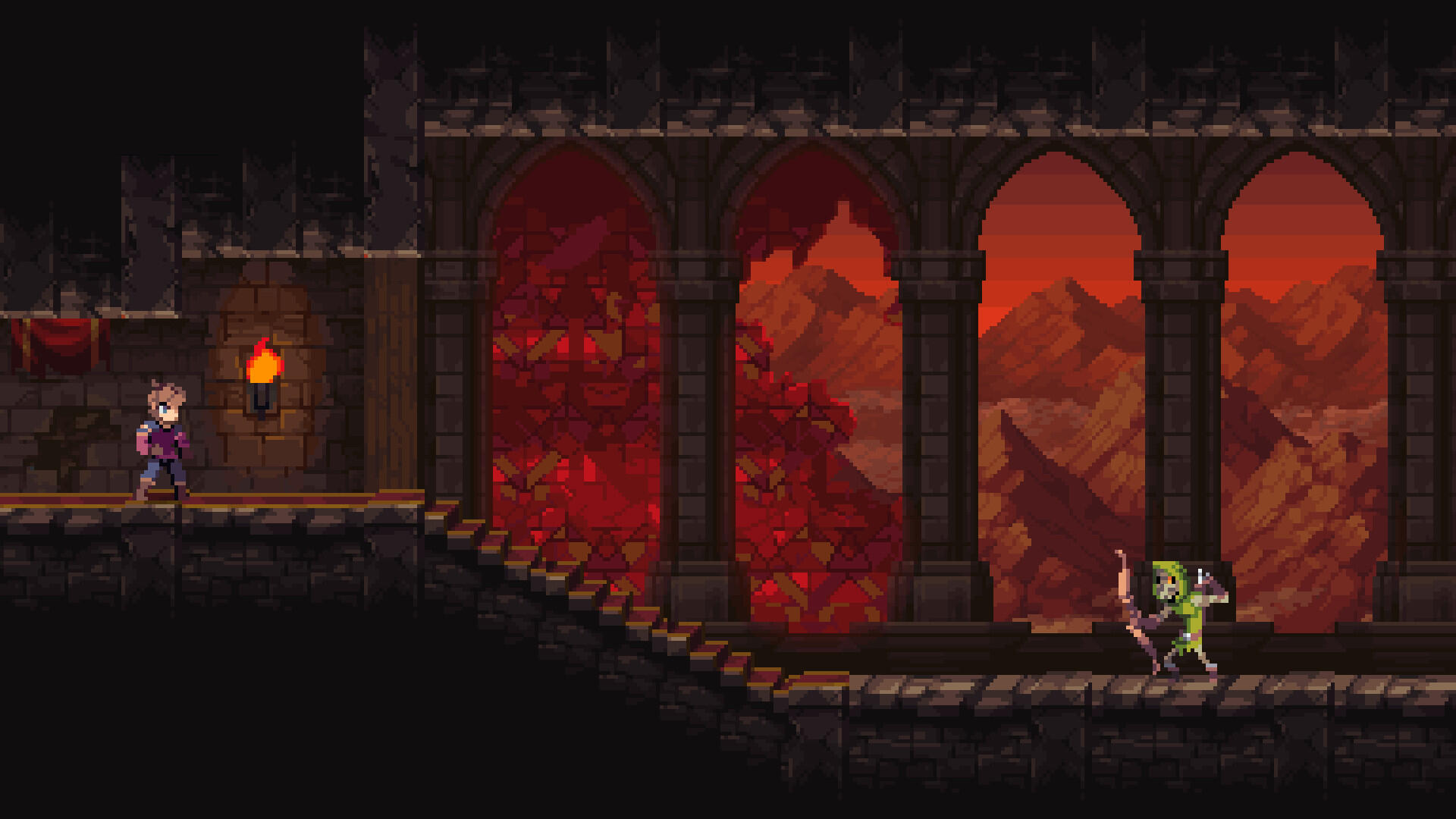
The first game that came to mind was Chasm, an RPG platformer that I started playing recently. The artstyle is very beautiful and detailed and I doubt I'd be able to replicate it or produce anything similar to it, but my main focus from this game is its use of colour.

Screenshots of gameplay from nintendolife.com [Link]


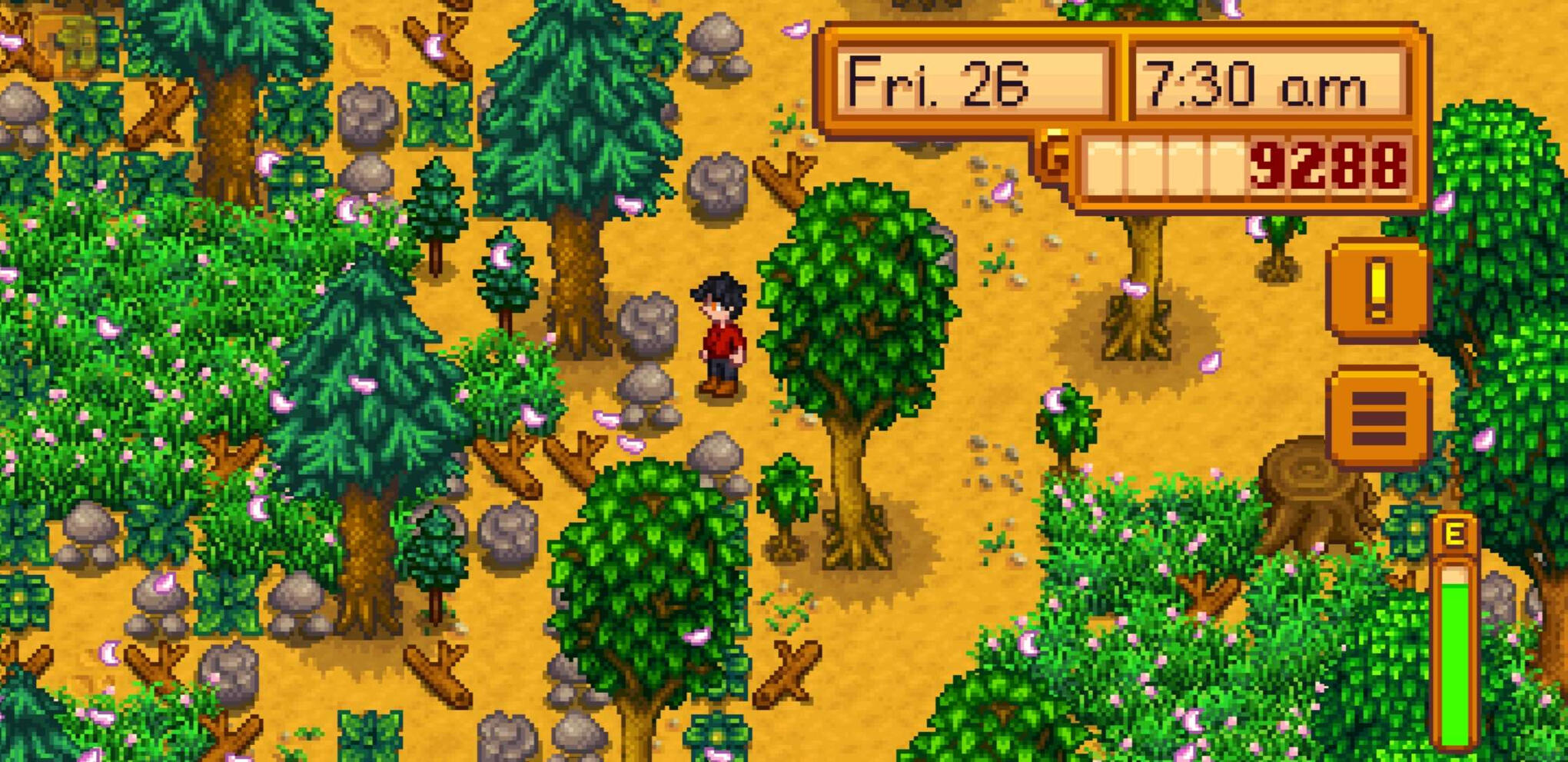
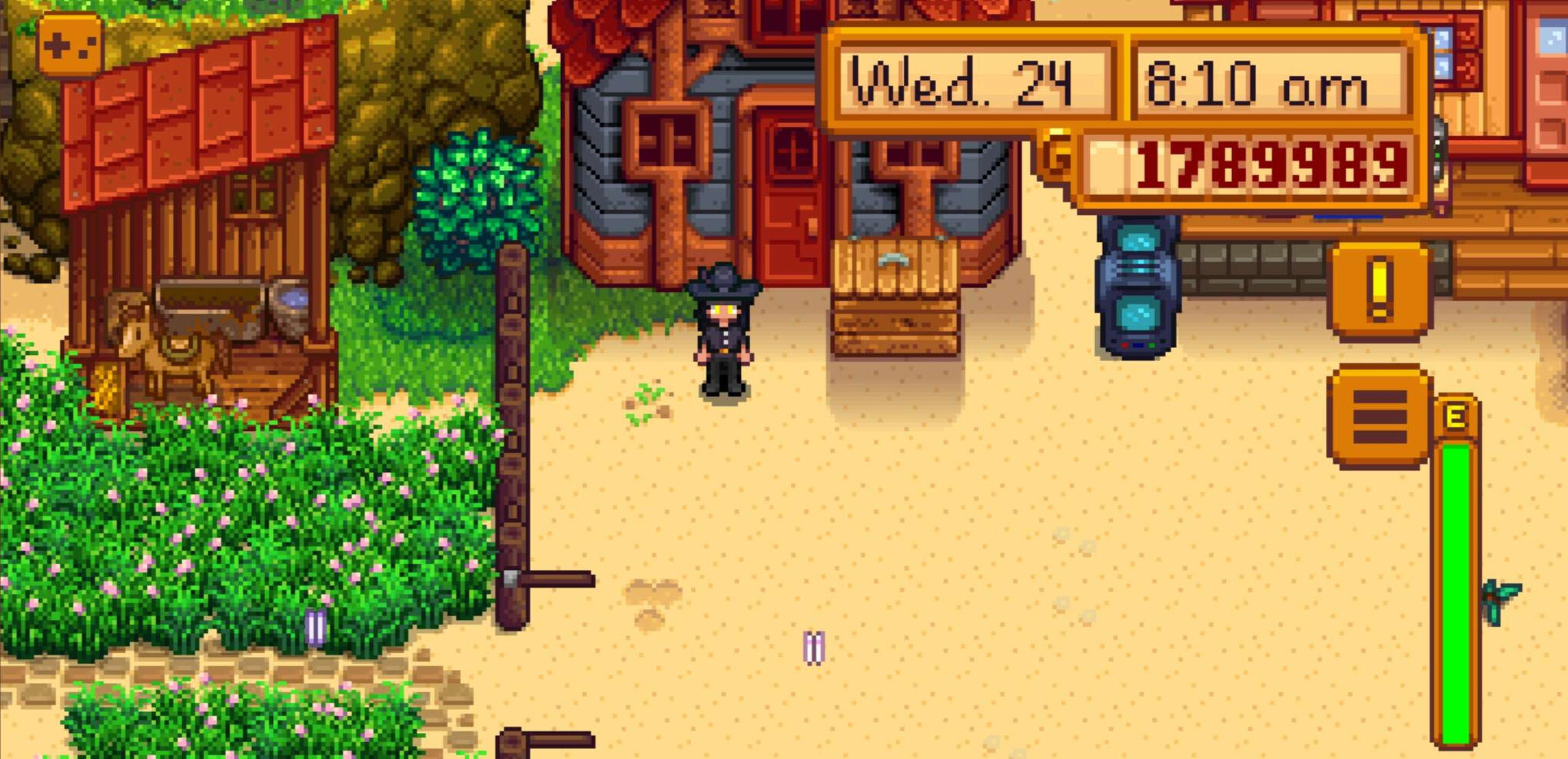
Another game I am taking visual inspiration from is Stardew Valley. I can definitely see myself producing a game that looks similar, and I also find the art of Stardew to be very charming, which is a similar sort of vibe to what I want to achieve with my game.

My own screenshots of gameplay


Distribution

Once my game has been made, I will have to figure out how I want to distribute it. The following is what I will likely do based on the research I have gathered.


Audience

Based on my previous research and feedback from my survey, the likely target audience of my game will range from 10yrs to 30yrs. I also think my game will reach people that are fans of indie games and RPGs, and possibly would also appeal to visual novel fans because of the story and character focus of my game.


Marketing

The marketing for my game will mostly be online through social media.Many indie games promote themselves through sites like YouTube, X (Twitter), and Twitch. I would likely also do this, through posting gameplay and art for the game on a dedicated social media website on X/Twitter, and uploading clips to YouTube. It would also be useful to request youtubers and twitch streamers with audiences that align with my target audience to play my game and upload it so that it has more reach.


Target platform

My game is currently only going to be developed for PC and for use with a keyboard and mouse, so will be limited to use on Windows/Mac/Linux. My target platforms will be Itch.io and Steam, but due to the high cost of publishing a game on Steam, I will likely only publish it on Itch.io in the initial period, as it is free to publish games and is well known amongst those who like to play indie games.


Game design

Themes

Fantasy/medieval, with a touch of comedy


Environment

My game's setting is based on medieval Europe, with some modern features added in, usually to make the prompt fit into my game, but also because the incongruence of it will be used for comedic effect.
The areas the player can explore include: the king's castle, the surrounding villages, the rolling hills leading up to a thick forest, as well as the forest itself and the dragon's cave within it.


Mechanics

The main game mechanics are dialogue trees and managing various stats, where the stats in question will determine how well (or poorly) the player's conversation will go. Not only will the player have to think about their own stats, but will also have to keep an eye on the dragon's, as if certain bars get too low, it will start lashing out at the player/NPCs. Choosing certain options in the dialogue trees also effect both the player's and the dragon's stats.
Another mechanic is exploration and item collection. Exploring opens up new interaction options with the dragon or other NPCs, and the items you can find and collect can give you various bonuses, as well as having the possibility of being equippable


Objectives

The core objective of the game is to defeat the creature destroying the kingdom, whether that be through befriending the dragon, or growing stronger so that you can kill it.
There are secondary goals in the form of minigames.


Types of fun

Fantasy and narrative, with elements of exploration


Concept art

Characters


environment


visual style


game world


game sprites


level designs


Evaluation

Work In Progress